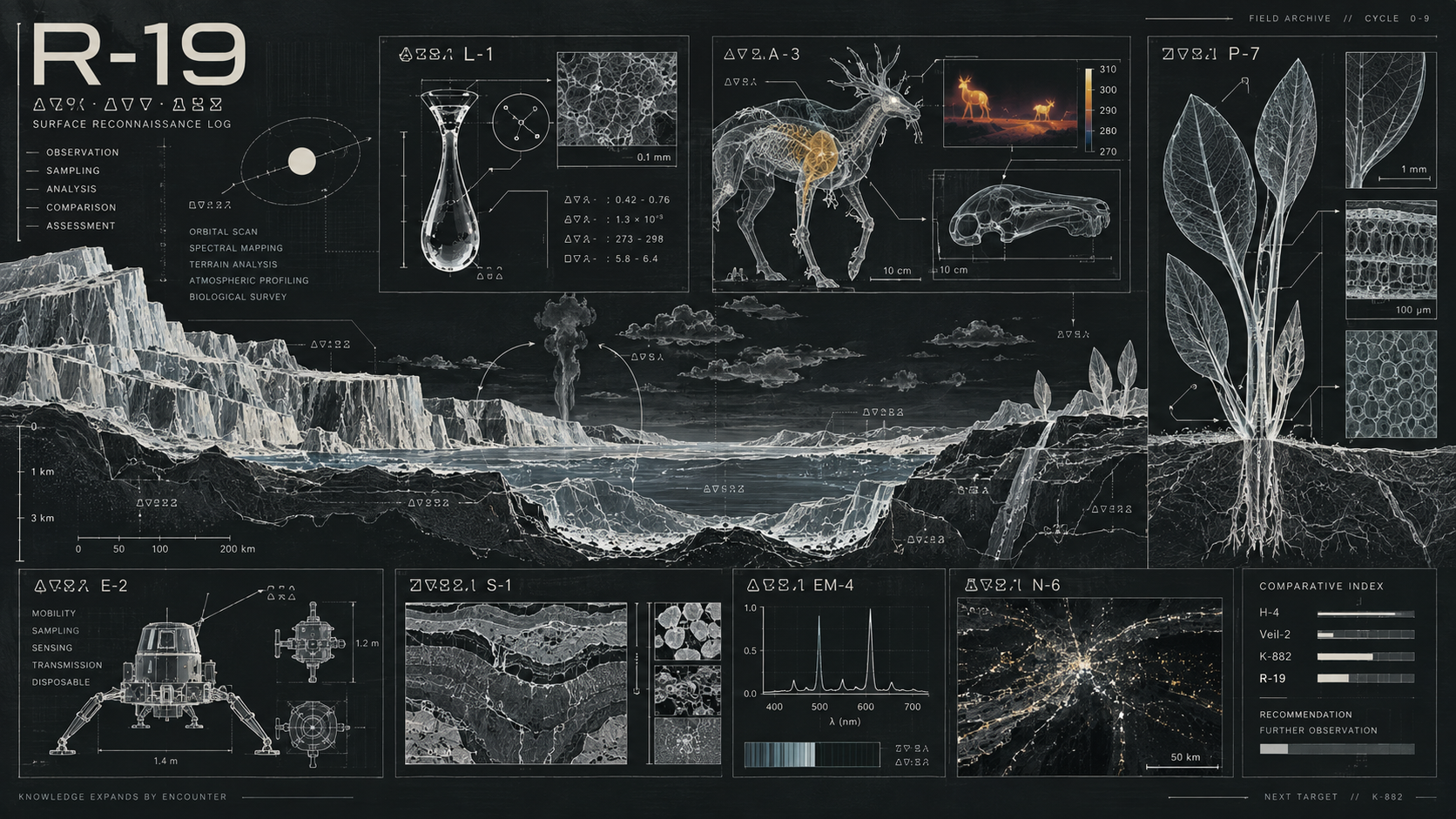
Rotation Cycle 0
After orbital mapping was complete, I rejected the initial landing plan. Approximately seventy percent of the target’s surface is covered by a single fluid medium. The remaining solid surface also exhibits widespread channels, deposits, and scour structures produced by its erosion. The substance is present in the lower atmosphere as well, periodically returning to the ground from above. There is therefore no genuinely safe dry zone. The atmosphere is a greater concern: roughly one fifth of the lower gas layer consists of a highly reactive oxidising component that ordinary exposed tissue cannot tolerate for long. Three extension bodies have already received replacement shells, but until the biological role of the liquid medium is established, I will not permit any bodily endpoint to enter the lower atmosphere.
Thermal scans nevertheless reveal numerous stable heat sources on the solid regions. Some maintain internal temperatures significantly above their surroundings for extended periods and move autonomously. This implies a continuous expenditure of energy merely to avoid reaching thermal equilibrium with the environment. If the interpretation is correct, complex life here not only inhabits the conditions described above but has adopted an expensive form of thermal management. I authorised sampling and switched the remote primary consciousness to continuous memory-return mode, in case subsequent losses of extension bodies exceed the budget.
Rotation Cycle 1
The first liquid sample was designated L-1. Both tissue experiments returned positive toxicity results. Initial contact rapidly disrupted ionic equilibrium across the exposed surface. The second experiment used an intact test organism; its respiratory structures ceased functioning in fewer than three standard subdivisions of contact. Once memory return was complete, I terminated the organism and classified L-1 as a high-risk contact substance. The lower-atmosphere oxidising gas produced similar results. It does not cause immediate tissue disintegration, but continuously damages several stable molecules. Any life that relies on this gas for metabolism must therefore bear a sustained cost of repair.
These two results would normally have been sufficient to cancel the surface mission. Thermal imaging from the same cycle overturned that judgement. The mobile heat sources are not only exposed to both hazardous substances over long periods; they also contain large quantities of L-1 and continuously take in the oxidising gas. The question is therefore not how they avoid these substances, but why they need them. Headquarters conducted the first low-order cognitive integration on the matter and concluded that the investigation should continue. Ecosystems that incorporate a highly reactive environment directly into their basic metabolism are inefficient, but uncommon in known life histories.
Rotation Cycle 2
Headquarters approved a trial landing in a high-reflectivity region. Remote sampling indicated that its principal surface material was not another mineral, but the low-temperature solid form of L-1. Without fluidity, its capacity to penetrate is greatly reduced, making it suitable as a temporary landing surface. I deployed eight extension bodies. During descent, one sank into deep deposits when the surface gave way, immobilising every structure below the thorax. As memory return was complete, I arranged no recovery and simply shut down that endpoint. The remaining seven continued towards lower elevations.
As temperatures rose, the surface material gradually softened and resumed flowing in the direction of gravity. Numerous stationary organisms along the route continuously absorb L-1 from below ground, then transport it through internal structures to heights tens or even hundreds of times their basal diameter. A substantial proportion subsequently re-enters the atmosphere. This is sufficient to establish that L-1 is not an environmental contaminant, but one of the fundamental media of the entire ecological cycle. I still advise against direct contact, but have permitted the extension bodies to proceed under double-layer isolation.
Rotation Cycle 3
The means by which mobile life acquires energy has been confirmed. Most large species cannot directly use stellar radiation. Instead, they periodically introduce other living structures into their bodies, obtain energy through mechanical fragmentation, chemical decomposition, and selective absorption, then expel the unusable remainder. I initially recorded this behaviour as interspecies aggression. Further observation showed that it recurs regularly even without territorial conflict. Some species actively cultivate other life solely to ingest its tissue once it matures.
From an engineering perspective, this is an exceptionally expensive metabolic pathway. An individual must first move to locate or produce another organism, render it partly or wholly inactive, then expend additional energy breaking it down. Only a fraction of the intake is usable, and the remainder requires active removal. Compared with direct use of environmental energy or controlled synthesis, the scheme entails obvious losses. Yet it has arisen independently on the target many times, indicating that long-term selection has not eliminated it. More unusually, most highly active organisms continuously maintain internal temperatures above ambient levels, further increasing daily energy consumption. The ecology group at headquarters suggests that this metabolic strategy may be associated with considerable environmental fluctuation, but the evidence remains insufficient.
Rotation Cycle 4
After the target region rotated onto the unilluminated hemisphere, numerous sources of narrow-band visible radiation appeared on the surface. Their distribution was highly concentrated, following regular linear structures and large aggregations. I initially suspected a form of nocturnal, collectively luminous life. Close inspection disproved this interpretation. The emitting structures have no metabolic activity; their energy arrives from elsewhere through conductors and is converted into visible wavelengths. The local technological organisms appear unwilling to suspend visual activity when their star is out of view, and have therefore manufactured enormous numbers of low-intensity light sources.
The presence of a technological civilisation is thus confirmed. Seen from above, the illuminated areas form a complex network. For a time, I suspected that the network itself might constitute some kind of slow subject. Thermal scans, however, showed that the actual autonomous units remain the numerous small, high-temperature organisms within it. Headquarters accordingly upgraded the mission from ecological investigation to candidate civilisation assessment, and opened limited shared-perception bandwidth to allow the language group to join in real time.
Rotation Cycle 5
Communication analysis has proved more difficult than expected. This civilisation has mastered long-distance electromagnetic transmission, yet relies heavily on variations in air pressure for close-range exchanges. Respiratory structures and local tissue vibrations compress information into a single acoustic channel, which another body reconstructs in temporal sequence. We initially classified the behaviour as ritual: its information density seemed too low for a mature civilisation to retain it as a primary means of communication. Only further observation established that it carries the overwhelming majority of immediate exchanges.
The limitations are evident. Only one linear message can be transmitted reliably at a time. Spatial relationships, degrees of certainty, emotional states, logical hierarchy, and action priorities all require additional encoding. Senders often cannot correct an earlier statement until several successive units have passed. When a receiver reconstructs something incorrectly, the parties generally do not exchange internal states directly; they transmit another sequence of pressure waves. The shared-perception group attempted to downgrade an ordinary field-state packet into the local format. The first conversion took forty-seven seconds and still lost the confidence layer, the temporal-reference layer, and two sets of parallel causal relationships.
This low-bandwidth mode of exchange appears, in turn, to have shaped their cognitive habits. They divide continuous thought into discrete symbols, then arrange those symbols in a fixed order. Much of their social activity is devoted to arranging them more precisely. They have also developed static symbolic records. Interestingly, this slow medium—which ought to be suited only to archives, technical specifications, and the fixation of law—holds considerable cultural prestige in their civilisation.
Direct communication is not recommended at this stage.
Rotation Cycle 6
The target technological species has a definite upper limit to its life cycle. I initially attributed tissue deterioration chiefly to the oxidising environment. Long-term records show, however, that even in the absence of accidents or acute disease, their bodies gradually lose the capacity for repair. Structural errors accumulate, activity declines, and eventually the entire subject ceases. More unexpectedly, this is not an occasional anomaly but the species’ default life course.
I initially assumed they possessed at least memory return, since they preserve enormous quantities of static text, images, acoustic recordings, and behavioural records, many specifically devoted to individuals who have ceased functioning. Further analysis shows that they regard these materials merely as records and do not consider them to contain continuity of the subject. In other words, an intelligent being can accumulate dozens of planetary orbital cycles of experience, preferences, relationships, and skills, then undergo permanent termination of its first-person process as a single body gradually fails.
This constraint has a far greater cultural impact than we first anticipated. Many social institutions appear to address the irreversible loss: inheritance, commemoration, continuation of bloodlines, historical records, and several belief systems centred on the subject’s persistence after death. Headquarters has instructed me to exclude memory-return technology from any future contact for now. In other surveys, premature demonstrations to civilisations that had not yet established subject-continuity engineering have caused severe social instability.
Rotation Cycle 7
Genetic data have explained much of the individual variation observed earlier. This species does not primarily reproduce by copying mature structures. Instead, two distinct reproductive categories each contribute a portion of genetic material, which undergoes extensive random recombination to form a new individual. Additional variation arises naturally during generation. Offspring are therefore not reliable copies of any existing individual. Many combinations do not improve upon the previous generation, and some contain obvious structural defects.
At first, I suspected an early population-optimisation technique: deliberately expanding a search space to discover new adaptive structures. The opposite is true. The process was not designed; it is their natural reproductive mechanism. Population adaptation relies chiefly on the prolonged accumulation of random changes followed by elimination. They first generate large amounts of unpredictable variation, then let the environment determine which differences may persist. Compared with controlled mutation, directed replication, and parallel screening across multiple generations, this method is slow and consumes many nonviable lives. It may, however, explain the target’s exceptional diversity of biological forms.
The language group notes that the local intelligent species attaches considerable social and emotional significance to this random genetic process. It should therefore not be understood simply as a breeding technique.
Rotation Cycle 8
The first two-way communication occurred midway through this cycle. Using their single-channel system, the other party asked the purpose of the mission, then how many members it contained. I answered one. They repeated the question and sent an image identifying the six surface extension bodies still active, two high-altitude extension bodies, and the orbital equipment. I again answered one.
We then spent considerable time resolving our counting criteria. This civilisation regards each structure with its own bodily boundary and local neural activity as a subject, rather than using continuity of primary consciousness as the principal criterion. Under this classification, they believed the mission comprised at least eight members. That definition cannot be applied directly to our mission structure. The eight extension bodies have no independent consciousness, nor are there eight sets of experience. They are simply eight simultaneous sensory and motor locations. All perception ultimately enters the same primary consciousness, and decisions are distributed from that consciousness to each bodily endpoint. There is consequently no communication between extension bodies in the proper sense, just as two sensory organs of one body do not need to introduce their current states to each other.
The other party then asked where the original structure carrying the primary consciousness was located. After the shared-perception group referred the question to headquarters for confirmation, I supplied the coordinates. A marked delay preceded their next vocalisation. Judging by their subsequent questions, they may only then have realised that the subject actually conducting the survey had never arrived at the target, and that all the “visitors” they had seen were remotely controlled biological instances.
This conceptual difference further increases the cost of direct exchange.
Rotation Cycle 9
The Civilisation Assessment Committee has completed its preliminary rating.
The target civilisation is classified as Pre-Integrated Consciousness; Tier Three Tool Society; Subject Continuity Not Established. This rating generally applies to technological populations capable of systematic environmental modification, intergenerational knowledge accumulation, and planetary-scale infrastructure, but still dependent on single-body subjects, natural heredity, and low-bandwidth symbolic communication. By the committee’s current standards, it has passed the threshold for purely ecological observation, but remains a considerable distance from formal civilisational relations.
The closest historical cases in the assessment archive include H-4 and Veil-2. At the time of its first survey, H-4 had controlled most naturally occurring diseases and established controlled genetic optimisation, but still insisted on a single body as the boundary of the subject. It independently discovered primary-consciousness transfer only some seven thousand two hundred local orbital cycles later. Veil-2 acquired distributed perception earlier, but went for a long period without developing memory-return technology. It was not promoted to the elementary integrated-consciousness level until its third review. Before either qualified for formal contact, both had first crossed the same threshold: the subject could no longer be permanently terminated by the failure of one biological structure.
R-19 has not even approached that stage.
Its rate of technological growth merits documentation. Yet it continues to devote substantial resources to more basic problems: maintaining food supplies, treating foreseeable diseases, managing group conflict, preserving experience that will inevitably be lost when individual subjects end after a few dozen orbital cycles, and coordinating large societies through low-bandwidth symbolic systems. At present, the other party cannot even receive one standard shared-perception unit in full. To force an equal exchange, we would have to keep compressing high-dimensional states into sequential symbols, then wait for them to respond point by point in the same fashion. This falls below the committee’s minimum efficiency requirement for formal exchange missions.
I have therefore withdrawn the application for continued contact.
This does not mean the civilisation lacks research value. Its ecological structures are rich, and its developmental path contains several anomalies worth comparing, particularly highly oxidative metabolism, random dual-source reproduction, and social organisation exceptionally dependent on acoustic symbols. These features make it more suitable as a life-history specimen than as a civilisational partner at this stage.
The committee accepted my recommendation and returned the target to the long-term review list. Review will be triggered by any of the following: reliable subject-transfer technology, continuous primary consciousness across bodies, non-symbolic high-bandwidth direct communication, or the first independent interstellar projection of primary consciousness. At the current rate of development, the automated model places the review window at least several hundred local orbital cycles in the future.
Active observation of R-19 will terminate at the end of this cycle. One listener without primary consciousness will remain in orbit to determine whether the target crosses any of these thresholds ahead of schedule. All remaining extension bodies will be shut down once memory return is complete.
The next survey target is K-882. Earlier remote data indicate that its technological population can already transfer the same subject continuously among three biological carriers, although subjective activity must still be suspended for approximately 0.4 seconds during transfer. If these data are accurate, it has at least reached the level of Veil-2 at its second review, and therefore offers the possibility of further exchange.
Course diversion recommended.
No further action on R-19 for now.