By seventeen, Eva already knew she would never be famous.
No one had told her. She had simply learned early to read the air in a casting room. When a girl who was really going to make it walked through the door, something always shifted, almost imperceptibly: the stylist looked up, the agent stopped talking, the photographer leaned a little forward from the back of his chair. It lasted only two seconds, but it was more convincing than any compliment.
That had never happened to Eva.
She was beautiful and well proportioned, with smooth, falling golden hair and flawless young skin the colour of honey. She knew when to relax her shoulders, when to ease her chin forward as though she had not meant to. At seventeen, she had shot catalogues for two Japanese brands and walked in a three-o’clock-in-the-afternoon show in Paris that no major publication had covered.
Her agent, Céline, liked to call her “very usable.” The first time Eva heard it, she thought it was praise. Later she understood that it meant something closer to a well-made white chair. It would fit in any room, but no one would buy a house because of it.
She developed a small habit. After every shoot, she would secretly watch the photographer delete pictures. Not to see which ones he kept, but which ones he deleted fastest. With some girls, the photographs required repeated comparison. Eva’s rarely did. The photographer usually knew at a glance which were no use.
At nineteen, she began having recurring pain above her left knee. At first she assumed it came from high heels and training, and the doctor treated it as an overuse injury. Three months later, while shooting a winter clothing campaign in Copenhagen, she suddenly could not stand and was taken to hospital. When the scans came back, everyone began speaking more slowly.
A malignant bone tumour.
Once chemotherapy began, she stopped working. Céline messaged twice a week, at length in the beginning, then more and more briefly. The industry was not cruel. It simply moved too fast. When a girl disappeared for six months, no one had to announce that she had been forgotten. Other bodies naturally filled her place.
The first time the doctor raised the possibility of amputation, Eva stared at the scan on the screen and asked, “How far above the knee?”
He indicated a point on his own leg, like someone marking a cutting line on a sample garment in a studio.
“Will I still be able to wear clothes like that?” she asked.
He thought she meant everyday life and began explaining prosthetics and rehabilitation. Eva listened for a while before interrupting. “I mean the runway.”
The doctor paused. With good rehabilitation, it was certainly possible, he said. But he could not answer on behalf of the fashion industry.
The operation was scheduled for a Thursday. Céline flew in to be with her and cried once in the hospital room. Eva did not cry. Instead, she suddenly remembered her first trip to Paris, sharing a cheap flat with six other girls, the bathroom mirror permanently clouded with steam. They went out together every morning and returned at night; whoever got a job was one day closer to moving out. Back then the world had felt excitingly vast, because any door might open. Now she realised for the first time that the same world could be so vast it had no need of her at all.
The operation went well. Recovery was faster than expected.
The first prosthetic leg the medical centre fitted her with was black carbon fibre: light, reliable, and ugly without distinction. Her rehabilitation therapist told her she could order a skin-coloured cover that would look almost like a real leg from a distance. Eva asked why it needed to. The therapist said many patients did not want their prosthesis to be the first thing people saw.
“I do.”
The words surprised even her.
Later, she found a designer who made stage machinery and had the shell made in polished metal. The first version was silver. Eva thought it looked like medical equipment. The second had a warm gold plating that caught the light in brilliant flashes. The mechanical knee was not concealed, and all the connectors remained exposed. The first time she put it on, she stood in the middle of the studio looking into the mirror for a long time.
It was the first time in her adult life she felt certain that, when she entered a room, people would look up.
She told no one.
She arranged the comeback photographs herself. Céline had suggested waiting until her condition was more stable, then starting with a series of soft portraits that emphasised her “return.” Eva refused. She borrowed a studio with bare concrete walls and wore an unadorned short black dress, leaving the gold prosthesis fully visible. She even asked the photographer to light her from the side so the metal would shine brighter than her skin.
After taking the first shot, the photographer stopped for a few seconds.
Eva saw it.
The two seconds she had been waiting for since she was seventeen.
Within forty-eight hours of the photographs going public, three magazines contacted Céline. A week later, a sportswear brand offered a global campaign. Two months later, Eva walked in a show that would never have considered her before. Backstage, the designer crouched down himself to adjust the hem so it would not cover the knee joint.
“Don’t hide it,” he said.
Eva looked down as he pinned the fabric up and felt a satisfaction that was almost quiet.
The gold prosthesis quickly became her signature. Brands wrote “redefining beauty” into their interview copy; the media called her “the golden girl.” On her first Vogue cover, she wore a plain white short dress, seated sideways, the metal leg stretching across the very centre of the frame. The cover editor had wanted her to smile. In the end, the photographer chose a picture in which she did not.
For the next two years, scarcely a month went unbooked. At a Paris show, someone replaced trousers with a short skirt at the last moment. A watch company had the colour of a metal bracelet adjusted specifically to match her prosthesis. Six-metre advertisements appeared in airport duty-free shops, the gold extending from her knee all the way to the second-floor escalator. Céline taught her how to say no, and each no made the next offer higher. Before, crew members had asked her name. Now people backstage only had to glimpse that flash of metal in the distance to know who had arrived.
The second pain appeared in her right leg.
At first it was only an ache at night. She did not tell Céline because she was flying to Morocco the next day to shoot a perfume campaign. On set, she stood on a dune with one foot sinking into fine sand when something seemed to wrench inside the bone of her right leg. The photographer thought her pose was uncomfortable and asked an assistant to bring a wooden board. Eva stood on it and kept shooting for six hours.
A little over two months later, the pain began to come when she walked.
She went to hospital for tests. During the hours she waited for the results, she was still choosing looks for the next season on her phone. When the doctor brought up the scans, she did not immediately understand what she was seeing. What made her understand was that he did not return to his chair. He stood up and closed the door.
Osteosarcoma again.
The lesion was in her right femur.
Her first thought was that she was going to die.
The thought was very brief and very specific. She did not think of a funeral. She thought of an unopened box of shoes in her wardrobe, a bottle of sparkling water in the kitchen that she had opened only yesterday, a brand waiting for her in Paris for a fitting the following week.
Then she thought of her right leg.
The first time she had been ill, “amputation” had been only a word until she woke up and it acquired weight. Now she knew the unnatural way the blanket would collapse after surgery. She knew the smell of the first dressing change on a residual limb. She knew how phantom pain could wake her at three in the morning with the sensation of nonexistent toes being gripped, one by one, in pliers. She knew, too, that she would hate her therapist the first time he made her stand.
Then she thought of work.
The thought came too quickly for her to feel ashamed of being shallow. The autumn campaign, the Paris show, the jewellery contract still halfway through negotiations. She thought of statements, cancellation penalties, even the rumour that Taylor Swift had insured her legs—perhaps she should have done that too, if only she had known.
Among these thoughts, another image flashed up, utterly out of place.
Two golden legs.
She had not chosen to imagine it. The image appeared by itself, as clean as a finished campaign: her body in the centre, perfectly symmetrical metal on either side, light falling from behind. Stranger than her first cover, and even less possible to confuse with any other model.
For an instant, it even brought a little excitement.
Almost immediately, Eva felt sick.
She did not know whether she was afraid of losing her other leg or calculating what she might gain from the loss. She did not know whether she feared death more, or surviving only to become someone no one needed again. All the feelings were there at once and made no sense together. Sitting there, she wished for the first time that someone could simply tell her what she should think in the next minute.
“What about saving the leg?” she asked.
The doctor said there was no longer a sufficiently safe limb-sparing option. Gently, he explained the risks of infection and tumour progression once more, then told her to go home and take time to think.
The operation was very successful. Throughout it, Céline thoughtfully kept work moving: some projects were cancelled, others postponed. Several longtime brands sent flowers. The creative director of the French fashion house recorded a personal video saying that what mattered most was that she survive. The sportswear brand emailed to say she would always be family. A Vogue editor called Céline to ask whether they needed help finding a better rehabilitation centre.
For the first two months after the right-leg operation, Eva did not think about work at all. Bilateral above-knee amputation was far harder than she had expected. The first time she put on two training prostheses, she stood for less than a minute before she began to shake. In the mirror, her body looked like a photograph whose composition had suddenly been cropped too far.
The second gold prosthesis took a long time to complete. Eva insisted that the right one should not copy the left. The old leg was already scratched, its gold surface worn thin at the ankle. The new one should be brighter, its joint simpler. Once she began learning to walk again, she sometimes asked Céline to film her so she could see herself approaching from different angles.
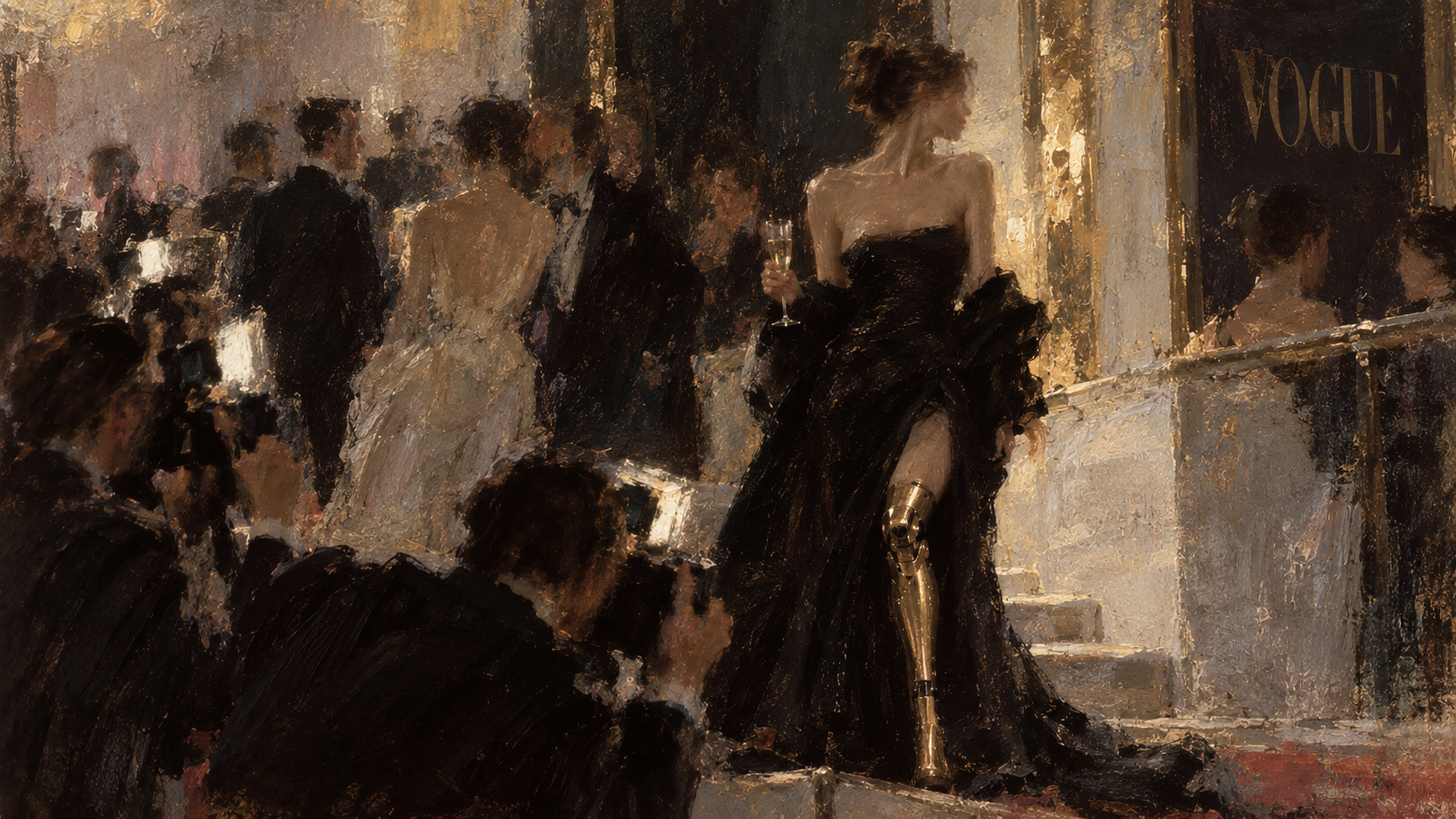
Her return was scheduled for a charity event six months later. She wore a black dress with a slit running up the front to her thigh, leaving both metal legs almost completely exposed. As she stepped out of the car, the photographers’ flashes thickened into a small thunderstorm. She paused at the entrance for less than ten seconds, but knew she had been right. The next day, her photographs filled the entertainment pages and social media. In them, her hair was cropped very short, her eyebrows almost gone, her skin pale from spending so long indoors. Her blue eyes looked sharply into the camera, and her two golden mechanical legs shone against the black velvet of her skirt.
As after her first comeback, her life quickly filled with calls and interviews. People placed the new photographs beside her first Vogue cover. Some called her “Golden Woman.” The headlines were even more extravagant this time. “TWICE AS STRONG.” “THE GOLDEN WOMAN RETURNS.” “BEYOND THE HUMAN BODY.”
Then everything began to stall.
A jewellery brand that had reached the contract stage moved its shoot from October to the following spring, citing a global budget adjustment. The French fashion house eventually chose another model for its new campaign, though its creative director still messaged Eva and suggested dinner the next time she was in Paris. The sportswear brand said it was restructuring its women’s line and would talk again in the next round.
Eva thought the explanations were reasonable. Couture and ready-to-wear campaigns required plenty of standing poses, and her walking really was not stable enough yet. Sportswear brands changed direction every few years, too.
But by Christmas, she had still signed no new contracts.
She called Céline in. “What’s happening?”
Céline said the market was adjusting.
Eva looked at her. “Don’t talk to me like an agent.”
Céline said nothing.
“Do they think I can’t walk a show?”
“No. They’ve already seen your tests.”
“Then what is it?”
“Some brands feel it’s… visually too strong.”
Eva did not understand at once. “What’s too strong?”
Céline did not answer.
Suddenly Eva found the phrase absurd. “One leg was just right?”
The room was silent.
She got up and walked a few steps across the office. The two gold prostheses struck the wooden floor with a harder sound than ordinary heels. People used to love that sound. They said the moment they heard it backstage, they knew she was there.
Eva laughed.
Meanwhile, another kind of email was arriving more and more often.
A sports-prosthetics company wanted her as its global ambassador. A major video game wanted to scan her body and capture her movements for a new character. An American production company sent a screenplay called Chrome Angel. On the cover, a blonde woman with a narrow waist and full hips stood with her back to the camera amid the rubble of a burning city. Her legs had been drawn as exaggerated golden mechanical semiautomatic weapons. The story followed a female mercenary who had lost both legs and was hunting organ traffickers across planets. The director was barely known. The budget was pitiful.
Céline put all these projects in a separate folder and did not volunteer to show it to her.
Eva saw it anyway.
“Why didn’t you tell me about this?”
Céline said nothing, only gave her a look that asked, Are you serious?
Eva turned a few pages. In the first scene, she crawled out of an explosion, revealed two metal legs, then kicked three people to death.
A man stared at her mechanical legs and asked, “Jesus, what are you?”
She answered, “Expensive.”
Eva laughed. “One leg sells watches. Two legs fight aliens. Career progression, I suppose. Take it.”
The film was shot in an Eastern European port city.
Its budget was scarcely higher than that of one of her old perfume commercials, and many scenes could only be shot once. The crew inhabited a world completely different from the one she knew. On a fashion set, a hundred people could spend half an hour discussing the position of a strand of hair. Here, the explosives specialist would tell her over lunch that they had one chance at the wall that afternoon. Once it was blown up, there was no second wall.
The costume budget was tight, so her two gold prostheses became almost the most expensive wardrobe in the film. The director, Simon, liked low angles. He would crouch in front of the monitor and watch her stride across a battlefield in towering heels, asking the cinematographer for minute adjustments so the joints would flash in the backlight. The stunt coordinator taught her to use the prostheses’ centre of gravity for falls that ordinary actors would find difficult. The art department even lowered a flight of stairs because the original height did not suit her moving up and down at speed.
Midway through the film, there was a harbour chase. She fought the villain in the rain, then fell into the sea.
The tank stood behind the studio. It was January, and the water was unheated. For the scene, she wore a very thin white shirt that would turn translucent and cling to her body when wet. There was no stunt double. Céline began arguing with the director on set. Eva stopped her and said it was all right, not to worry.
When she actually went in, the cold still left her almost unable to breathe.
The water surged from her chest to her neck. A sharp chill struck both residual limbs around the sockets. During the seconds she was submerged, everything around her turned a murky green. Artificial rain hammered the surface, and the voices of the people on the edge reached her through the water as nothing more than indistinct vibrations.
For some reason, she suddenly remembered her first visit to a public swimming pool as a child.
It had been late September, the final weekend before the outdoor pool closed for the season. She was about seven. Her father told her the water was too cold and not to go in. While he went to buy drinks, she climbed down the ladder herself. The first step was so cold she drew her foot back. Then, little by little, she lowered her whole body into the water.
Some of the blue paint on the bottom had begun to peel. She remembered holding on to the edge, afraid to let go, and wanting desperately to swim to the other side.
It was an autumn evening. The sun was already low, its last light slanting across the water, broken by tiny ripples into fragments of gold. The sky shifted from gold and pink near the sun through red and purple to the palest blue, so luminous that she could hardly tell whether it looked more like sunrise or sunset. She remembered a strange feeling, but she had been too young then to know what to call it. As though something good was just about to happen, and as though, before it could happen, she had already lost something.